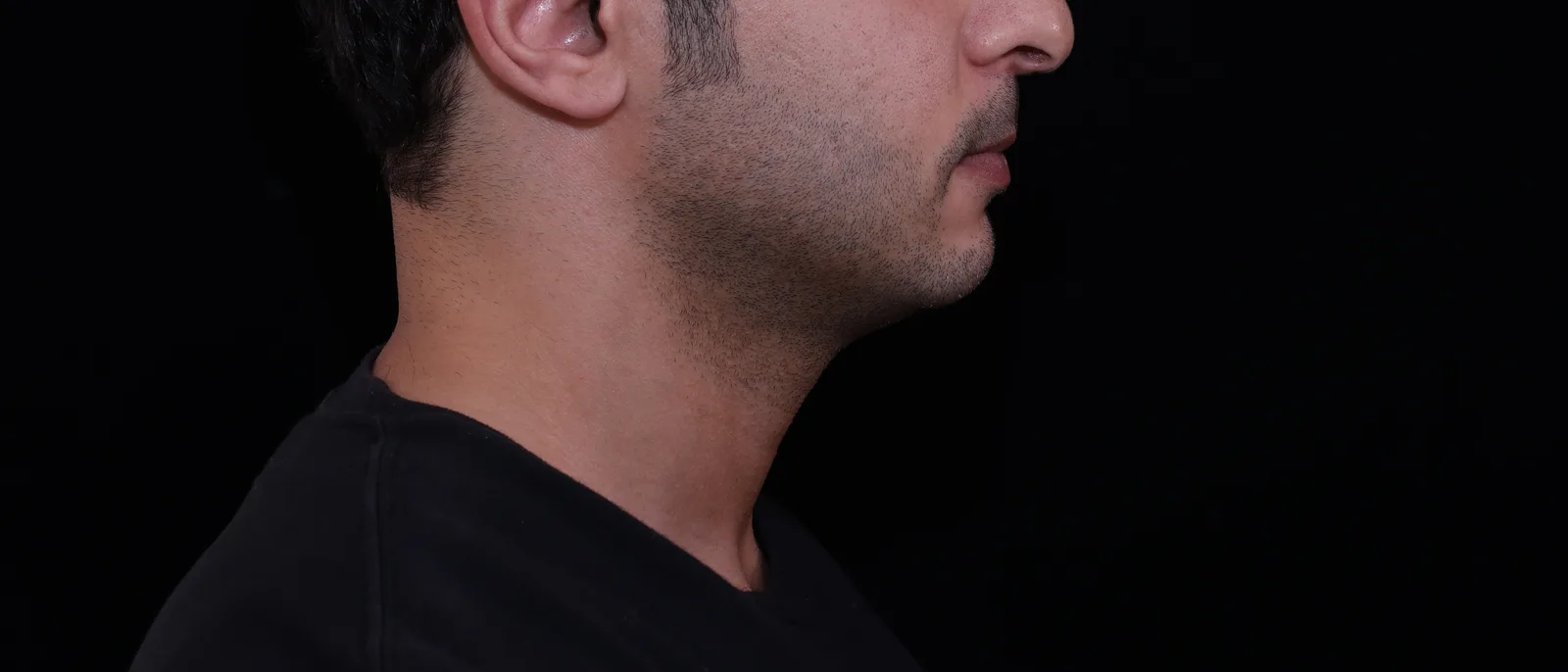
The best results are not obvious. They simply make the face feel more balanced and defined.
The chin and jawline shape the lower face and play a key role in overall facial proportions. They influence how the face is perceived in terms of structure, balance, and definition.
At Skinbeat Medical Center in Dubai, chin and jawline contouring is approached as a structural treatment, often within a non-surgical facelift or full face rejuvenation strategy. The goal is not to exaggerate features, but to restore balance, improve proportions, and create results that integrate naturally with the face.
Why Chin and Jawline Matter
The lower face completes the facial shape and determines, to a large extent, how feminine or masculine a person appears. As such, it has a strong influence on facial attractiveness and first impressions.
Feminine and masculine lower faces differ in structure:
- In women, the chin is typically more delicate and rounded, contributing to a softer, more oval facial shape. The lower face is often slightly less prominent than the midface. The mandibular (gonial) angle is typically wider, often greater than 135°, and the ramus is shorter.
- In men, the midface and lower face tend to be more equal in proportion, often contributing to a more square facial shape. The chin is wider and stronger. The mandibular (gonial) angle is narrower, often less than 130°, and the ramus is longer.
These structural differences influence how the face is perceived.
Facial Proportions
A key concept in aesthetic assessment is the rule of thirds.
The face is ideally divided horizontally into three equal parts:
- Upper third (forehead)
- Middle third (midface)
- Lower third (lower face)
The lower third plays an important role in overall balance. Even small variations in chin projection, height, or jawline definition can influence how the face appears.
Who Is This Treatment For
Chin and jawline contouring may be appropriate for patients who notice:
- A retruded or under-projected chin
- A short or vertically deficient chin
- Lack of jawline definition
- Early jowling or softening of the lower face
- Sagging of the lower face or reduced structural support
- Imbalance between the chin, lips, and nose
- A desire to enhance facial structure while maintaining natural results
Assessment of the Lower Face
A detailed assessment is performed before treatment, often with a strong focus on profile view.
This includes:
- Mandibular (gonial) angle
- Ramus length
- Facial convexity
- Chin position and projection
- Vertical height of the chin
- Cervicomental angle
This helps guide a precise and individualized treatment plan.
Understanding Changes Over Time
Changes in the lower face occur gradually and involve both structural and soft tissue components:
- Reduction in bone support, leading to a shorter and more retruded chin
- Changes in lip volume and definition (see lip fillers)
- Soft tissue laxity contributing to jowl formation
- Submental skin excess affecting jawline definition
It is important to distinguish between:
- A naturally underdeveloped lower face
- Age-related changes affecting structure and soft tissue
Each requires a different treatment approach.
Treatment Approach
Chin and jawline contouring is performed using a structured, multimodal approach.
Treatment may include:
- HA fillers to improve chin projection, shape, and jawline definition
- Correction of asymmetries and structural imbalances
- Biostimulators to support soft tissue quality
- Neuromodulators to improve platysma-related changes
- Energy-based devices to improve skin tightening and submental laxity
- Lipolytic injectables to address submental fat when appropriate
Treatment is always tailored to the individual.
Double Chin (Submental Fullness)
A double chin is one of the most common reasons patients seek jawline treatment — and one of the most misread. Fullness under the chin may come from localized fat, from skin and tissue laxity, or from a chin that sits further back than it should, and each cause is treated differently.
- True submental fat can be treated non-surgically with lipolytic injectables
- Laxity responds to energy-based devices and tissue tightening
- A retruded chin is a structural question — often the double chin softens once projection is restored
Because the chin, jawline, and neck are read together, this assessment overlaps with neck rejuvenation — the two plans are often one.
Balanced, Natural Results
A natural result is not defined by sharpness alone.
- A defined jawline without a balanced chin may appear incomplete
- A projected chin without harmony with surrounding features may appear unnatural
The objective is always to create a balanced and well-integrated result.
What to Expect
After treatment:
- Mild swelling or bruising may occur
- Temporary asymmetry can be seen during early settling
- Results become more defined over one to two weeks
Most patients return to normal activities the same day or shortly after treatment.
Maintenance and Long-Term Approach
With a structured plan:
- Results remain stable over time
- Smaller adjustments are needed
- Outcomes remain natural and consistent
Treatment evolves with the patient over time.
Safety
At Skinbeat Medical Center:
- Treatments are performed using clinically validated products and technologies
- This includes HA fillers, biostimulators, neuromodulators, and energy-based devices
- A strong emphasis is placed on safety, precision, and individualized care
The Skinbeat Philosophy
We do not treat isolated areas. We treat the face as a whole.
Chin and jawline contouring achieves its best results when integrated into a full-face approach, often combined with:
The lower face plays a defining role in how the face is perceived.
When structure is restored and proportions are balanced, the face appears more defined, more harmonious, and more natural.